


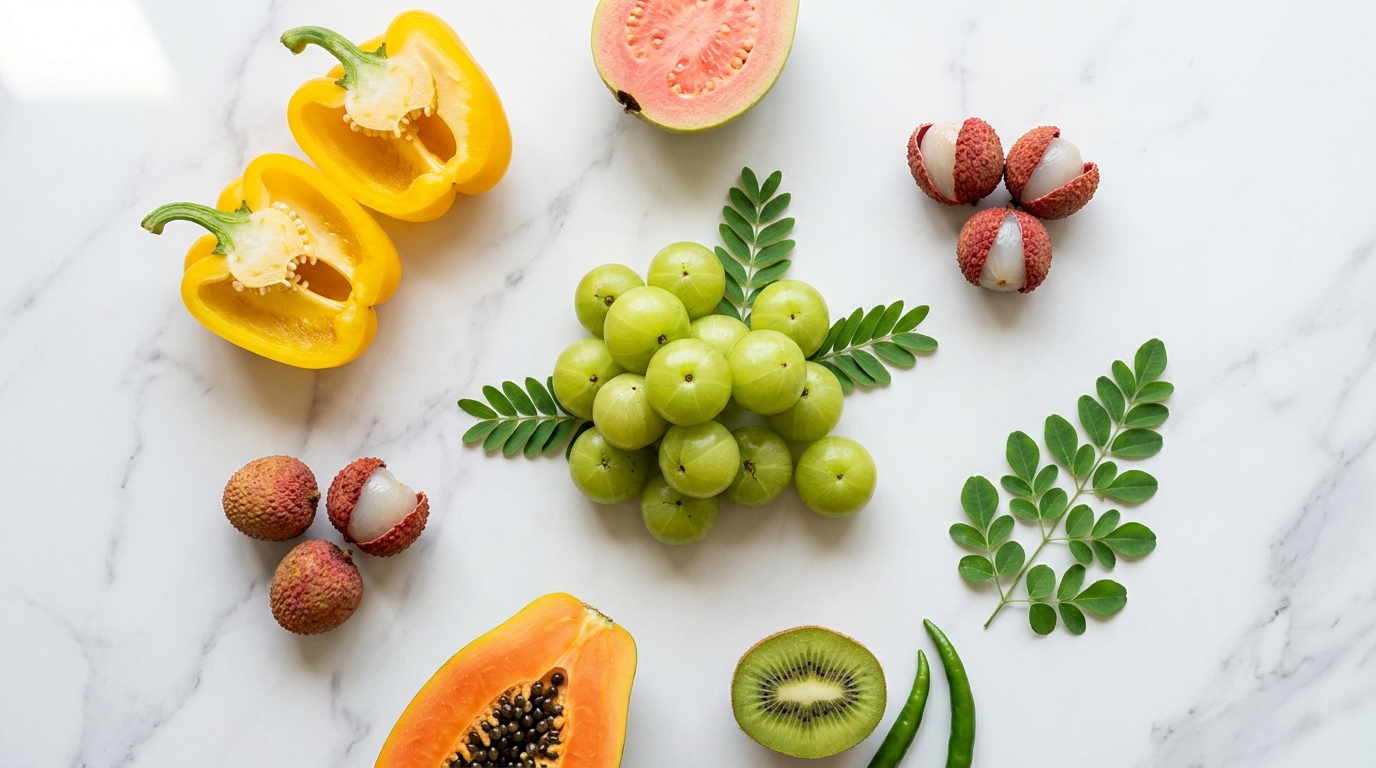
Reviewed for nutritional accuracy against NIH, USDA, and peer-reviewed literature.
Vitamin C (ascorbic acid) is a water-soluble essential nutrient your body cannot produce on its own. It is required for collagen synthesis, immune defense, iron absorption, and antioxidant protection. The daily recommended value is 90 mg for adult men and 75 mg for adult women — thresholds that are surprisingly easy to miss on a busy day.
Most people think of oranges. That is where the knowledge stops. But oranges sit at just 53 mg/100 g,, and at least a dozen foods widely available in Indian and South Asian markets deliver far more vitamin C per bite. The problem is nobody talks about them in the same breath.
This article fixes that. Here is exactly what you will find:
- A ranked list of 25 foods with verified mg/100g data from USDA FoodData Central
- Practical tips for each food how to eat it, prepare it, and find it locally
- Honest guidance on where a supplement like Koshnutra Amla Care Powder fits into a real daily routine
Signs You May Not Be Getting Enough Vitamin C
Vitamin C deficiency can develop within 4–6 weeks of inadequate intake. It does not announce itself loudly. It starts quietly — with fatigue you blame on sleep, skin you blame on weather, and wounds that just seem slow to close.
The progression follows a predictable pattern:
| Stage | Timeframe | Symptoms |
| Early deficiency | 4–6 weeks of low intake | Fatigue, irritability, loss of appetite |
| Moderate deficiency | 1–3 months | Dry/rough skin, slow wound healing, joint pain, weakened immunity |
| Severe deficiency (Scurvy) | 3+ months | Bleeding gums, bruising, hair loss, bone pain, depression |
If any of this sounds familiar, you are not alone and it is fixable. The food and supplement options in this article are a practical place to start. Persistent or severe symptoms warrant a visit to your doctor.
Clinical reference: StatPearls / NCBI — Vitamin C Deficiency. Do not self-diagnose. Consult a healthcare provider for persistent symptoms.
Quick Reference: 25 Foods Ranked by Vitamin C Content
Here is the complete ranked list, sorted by vitamin C per 100 grams. The Practical Access column reflects real-world availability — particularly for buyers in India and South Asia.
| # | Food | Vit C (mg/100g) | % Daily Value | Practical Access |
| 1 | Amla (Indian Gooseberry) | 600–700 mg | 667–778% | ✓ Easy (supplement) |
| 2 | Kakadu Plum | 2,907 mg | 3,230% | ✗ Rare |
| 3 | Acerola Cherry | 1,677 mg | 1,863% | ✗ Rare |
| 4 | Rose Hip | 426 mg | 473% | ✓ Moderate |
| 5 | Yellow Bell Pepper | 184 mg | 204% | ✓ Easy |
| 6 | Guava | 228 mg | 253% | ✓ Easy (India/Asia) |
| 7 | Chili Pepper (Green) | 109 mg | 121% | ✓ Easy |
| 8 | Mustard Spinach (raw) | 195 mg | 217% | ✓ Easy (Asia) |
| 9 | Black Currant | 181 mg | 201% | ✓ Moderate |
| 10 | Kiwi | 93 mg | 103% | ✓ Easy |
| 11 | Broccoli | 89 mg | 99% | ✓ Easy |
| 12 | Kale | 93 mg | 103% | ✓ Moderate |
| 13 | Brussels Sprouts | 85 mg | 94% | ✓ Moderate |
| 14 | Lychee | 72 mg | 80% | ✓ Easy (India/Asia) |
| 15 | Papaya | 62 mg | 69% | ✓ Easy (India/Asia) |
| 16 | Strawberry | 59 mg | 66% | ✓ Easy |
| 17 | Pummelo | 61 mg | 68% | ✓ Easy (India/Asia) |
| 18 | Orange | 53 mg | 59% | ✓ Easy |
| 19 | Lemon | 53 mg | 59% | ✓ Easy |
| 20 | Moringa Leaves | 51 mg | 57% | ✓ Easy (India/Asia) |
| 21 | Red Cabbage | 57 mg | 63% | ✓ Easy |
| 22 | Parsley | 133 mg | 148% | ✓ Easy |
| 23 | Cantaloupe | 37 mg | 41% | ✓ Easy |
| 24 | White Potato | 19 mg | 21% | ✓ Easy (everyday) |
| 25 | Tomato | 23 mg | 26% | ✓ Easy (everyday) |
25 High Vitamin C Foods — What They Are and How to Use Them
Data sourced from USDA FoodData Central. All values are per 100 grams of fresh, raw food unless otherwise noted.
Tier 1 — Exceptional Sources (400 mg+ / 100g)
1. Amla (Indian Gooseberry) — 600–700 mg / 100g
One amla contains more vitamin C than 12 oranges. It is the most accessible super-concentrated source in the world.
Amla delivers 600–700 mg of vitamin C per 100g over 7× the daily recommended value in a single small fruit. It has been central to Ayurvedic medicine for centuries, and modern nutrition science backs that tradition. The vitamin C in amla is bound with tannins, which may stabilize and slow oxidation — meaning the nutrient survives processing better than in most raw fruits.
Key benefit: Potent antioxidant protection, immune support, and collagen synthesis.
Practical tip for India: Fresh amla is seasonal (October–March), but amla powder is available year-round at any grocery store or online. Mix into water, smoothies, or lassi. Amla murabba (preserve) is widely eaten, though the sugar content reduces its nutritional profile vs. fresh or powdered amla. Not sure which form works best for you? See: Amla Powder vs Raw Amla — Which Is Better for Daily Health?
Cooking note: Avoid boiling. Use powder in unheated preparations for maximum vitamin C retention.
2. Kakadu Plum — 2,907 mg / 100g
The Kakadu plum holds the world record for natural vitamin C content — up to 2,907 mg per 100g. That is roughly 32× more than an orange. Native to Australia and harvested from wild trees in the Northern Territory, it has been eaten by Aboriginal communities for tens of thousands of years.
Reality check: You will not find this at your local market in Mumbai, Delhi, or Bangalore. It exists primarily in specialty Australian health products. We include it for completeness — and because it makes every other fruit look modest by comparison.
3. Acerola Cherry — 1,677 mg / 100g
Native to the Caribbean and Central America, the acerola cherry contains 1,677 mg of vitamin C per 100g. You will rarely encounter fresh acerola in India or South Asia, but it appears in premium supplement powders and some health drink formulations. If you see acerola on a supplement label, it indicates a whole-food vitamin C source.
4. Rose Hip — 426 mg / 100g
The fruit of the rose plant — often called the forgotten vitamin C berry — delivers 426 mg per 100g. Rose hip tea, widely available in India, provides meaningful vitamin C provided it is not steeped in boiling water for extended periods. Dried rose hip powder is accessible through Ayurvedic and herbal suppliers.
Practical tip: Steep rose hip tea in water below 70°C to preserve more of its vitamin C content.
Tier 2 — High Sources (100–400 mg / 100g)
5. Yellow Bell Pepper — 184 mg / 100g
Yellow bell pepper contains nearly 3.5× more vitamin C than an orange, and it is available in most Indian supermarkets. Red bell peppers follow closely at around 128 mg/100g. Green bell peppers contain the least of the three varieties.
Practical tip: Eat raw in salads or with dips. Stir-frying over high heat for under 5 minutes retains 65–75% of the vitamin C content.
6. Guava — 228 mg / 100g
Guava is one of India’s most underrated superfoods. At 228 mg per 100g, a single medium guava (around 150g) delivers more than 3× your daily vitamin C requirement. It is inexpensive, seasonal, widely grown across the country, and eaten raw as a common afternoon snack across North and South India alike.
Practical tip: Eat with the skin on — the peel contains concentrated vitamin C. Add chaat masala and eat raw for the highest nutrient retention.
7. Green Chili Pepper — 109 mg / 100g
The humble green chili — present in nearly every Indian meal — contains 109 mg of vitamin C per 100g. A two-chili serving with dal or sabzi quietly delivers 20–30 mg of vitamin C. It does not need to be a supplement; it needs to be recognised.
8. Mustard Spinach (Sarson) — 195 mg / 100g
Raw mustard spinach delivers 195 mg/100g, making it one of the highest-vitamin-C leafy greens available. Widely used in North India (sarson ka saag), it is most nutritious when lightly cooked or blanched — heavy cooking significantly reduces its vitamin C content.
9. Black Currant — 181 mg / 100g
Black currants contain 181 mg/100g and are more accessible in Kashmir and northern hill regions of India than in other parts of the country. They are increasingly available frozen or as juice concentrate in urban health stores.
Tier 3 — Good Sources (50–100 mg / 100g)
10. Kiwi — 93 mg / 100g
A single kiwi (approximately 70g) delivers about 65 mg of vitamin C — nearly a full day’s requirement. It is widely available across India, particularly in winter months, and is one of the easiest fruits to add to breakfast bowls and smoothies.
11. Broccoli — 89 mg / 100g
Broccoli delivers 89 mg of vitamin C per 100g raw. Steam it for 5–7 minutes and you retain 70–80% of that content. Boil it and you lose roughly half, with much of the vitamin C leaching into the cooking water.
Practical tip: Use the cooking water in soups or sabzis — the vitamin C is in the liquid.
12. Kale — 93 mg / 100g
Kale has become increasingly available in urban Indian supermarkets. At 93 mg/100g it is on par with broccoli. Best eaten in salads, lightly sautéed, or blended into smoothies. Cooking reduces its vitamin C content significantly.
13. Brussels Sprouts — 85 mg / 100g
Less common in India but worth knowing — particularly for Indian families in the UK, Australia, or North America. Brussels sprouts deliver 85 mg/100g and are best roasted or steamed briefly.
14. Lychee — 72 mg / 100g ★ India Spotlight
Widely available at Indian fruit markets from May to June. One of the most cost-effective vitamin C sources in the country during peak season.
Lychee delivers 72 mg/100g during a short but intense summer season. A cup of lychees (about 190g) provides more than the full daily vitamin C requirement. Bihar, Jharkhand, West Bengal, and Uttarakhand are India’s primary lychee-producing states.
15. Papaya — 62 mg / 100g ★ India Spotlight
Available year-round across India. One of the most practical daily vitamin C fruits for the price.
Papaya offers 62 mg/100g and is available across India for most of the year at an affordable price point. It is also rich in vitamin A and digestive enzymes. A medium-sized bowl of papaya (200g) contributes approximately 140% of your daily vitamin C requirement.
16. Strawberry — 59 mg / 100g
Strawberries deliver 59 mg/100g. They are seasonal in India (December to March in hill regions, Maharashtra, and Himachal Pradesh) but widely available frozen or as fresh imports in urban markets year-round. Eat raw — cooking destroys most of their vitamin C.
17. Pummelo — 61 mg / 100g ★ India Spotlight
Chakotara / Pomelo — common across South India, Maharashtra, and Assam. Underused and underrated.
Pummelo (chakotara) delivers 61 mg/100g and is widely available in South and Northeast India at a fraction of the cost of imported citrus. Its large serving size means a single fruit can provide well over the daily vitamin C requirement.
18. Orange — 53 mg / 100g
The classic benchmark. Oranges deliver 53 mg/100g — respectable, but far from the top of this list. Nagpur oranges, Coorg oranges, and Darjeeling mandarins are widely accessible across India. Freshly squeezed juice retains most of the vitamin C provided it is consumed immediately.
19. Lemon — 53 mg / 100g
Lemon delivers 53 mg/100g and is used daily in virtually every Indian household. The squeeze of nimbu over dal, sabzi, or chaat is not just flavour — it is a meaningful contribution to vitamin C intake. One full lemon (50–60g) contributes about 25–30 mg of vitamin C.
20. Moringa Leaves (Drumstick Leaves) — 51 mg / 100g ★ India Spotlight
Drumstick leaves (sahjan ke patte) are one of the most nutritionally dense vegetables in Indian cooking. Available year-round in South India.
Moringa delivers 51 mg/100g alongside exceptional protein content (for a vegetable), calcium, and iron. It is particularly common in South Indian cooking — in sambar, kootu, and stir-fries. Moringa powder is also increasingly available as a wellness supplement. For a deeper look at everything moringa can do: Moringa Benefits: What Science Really Says (And How to Actually Use It).
Tier 4 — Accessible Everyday Sources (20–57 mg / 100g)
These foods will not make headlines for their vitamin C content alone, but they show up in Indian kitchens daily — and that consistency matters.
21. Red Cabbage — 57 mg / 100g
Red cabbage delivers 57 mg/100g — more than orange per gram — and is available affordably across India. Eat it raw in slaws or lightly stir-fried to retain the most vitamin C.
22. Parsley — 133 mg / 100g
Parsley is high in vitamin C by weight (133 mg/100g), but used in small quantities as a garnish. If you use it liberally in chutneys or salads, the contribution is meaningful.
23. Cantaloupe (Kharbooja) — 37 mg / 100g
Kharbooja is a widely loved summer fruit across India, available from April to August. At 37 mg/100g, a generous serving contributes a useful fraction of daily vitamin C. Its high water content also supports hydration.
24. White Potato (Aloo) — 19 mg / 100g
Aloo is not vitamin C royalty, but it is the most consumed vegetable in India by volume. Eaten at scale, three medium potatoes contribute 30–40 mg of vitamin C — roughly a third of your daily requirement. Baked or steamed potatoes retain more vitamin C than boiled ones.
25. Tomato — 23 mg / 100g
Tomato appears in nearly every Indian meal in some form — raw in salads, cooked in curries, pureed in sabzis. While not individually impressive, the sheer frequency of consumption makes tomatoes a consistent background contributor to daily vitamin C intake.
How to Preserve Vitamin C When Cooking
Heat above 60°C begins to degrade vitamin C. Prolonged boiling can destroy 50–70% of it — and the remainder leaches into the cooking water. This is why eating a vegetable-rich Indian thali does not automatically translate into high vitamin C intake if everything is pressure-cooked or long-simmered.
| Cooking Method | Vit C Retained | Recommendation |
| Raw / Uncooked | ~100% | Best — always preferred when possible |
| Steaming (5–7 min) | ~70–80% | Excellent — minimal water contact |
| Stir-frying (quick) | ~65–75% | Good — short heat exposure |
| Blanching (briefly) | ~50–65% | Acceptable — discard cooking water |
| Boiling (long) | ~30–50% | Avoid — vitamin C leaches into water |
| Pressure cooking | ~50–60% | Mixed — improves bioavailability of other compounds |
Three practical rules to follow in your kitchen:
- Store fruits and vegetables in a cool, dark place — vitamin C degrades with light and heat exposure.
- Cut produce just before eating — surface area accelerates oxidation.
- If boiling is unavoidable (rasam, soups, dal), use the cooking water in the dish itself — the vitamin C is in the liquid.
Why Amla Is the Most Practical High-Vitamin-C Food You Can Add Today
Kakadu plum and acerola cherry top the global ranking. But you cannot buy them in your neighbourhood. Amla, you can.
Amla is where exceptional nutrition meets genuine everyday access. A single 100g serving provides 600–700 mg of vitamin C — more than 7× the daily recommended value, and roughly 12× more than an orange. Fresh amla is seasonal, but amla powder is one of the most stable, widely available wellness ingredients across India — in every health store, Ayurvedic pharmacy, and e-commerce platform year-round.
Here is what makes the vitamin C in amla biochemically distinct: it is bound with naturally occurring tannins. Unlike synthetic ascorbic acid, this tannin-ascorbic acid complex may slow oxidation and enhance stability during processing. This is why quality amla powder retains meaningful vitamin C content — rather than degrading rapidly the way sliced fresh fruit does once exposed to air. For a comparison of amla varieties, see Bhumi Amla vs Amla: Which One Is Better?.
Scientific reference: Dasaroju S, Gottumukkala KM. Present status of amla (Emblica officinalis Gaertn.) — a review. IJPSR, 2014. Tannin-ascorbic acid interaction and stability data referenced from peer-reviewed phytochemistry literature.
Koshnutra Amla Care Powder — Product Overview
Disclosure: Koshnutra Amla Care Powder is a client product featured in this article. All health benefit claims are based on ingredient-level evidence. This is not medical advice.
What Is Koshnutra Amla Care Powder?
Koshnutra Amla Care Powder is a premium wellness supplement built around amla extract as its core ingredient. Unlike basic amla powder or synthetic vitamin C supplements, it is formulated as a multi-system supplement — addressing vitamin C intake, gut health, immunity, and metabolic support simultaneously, in a single daily scoop.
It is maltodextrin-free — a meaningful distinction, since maltodextrin is a cheap filler used in most mass-market supplement powders that can spike blood glucose and deliver empty calories.
What Is Inside — Ingredient Breakdown
- Amla Extract — Primary vitamin C source. Whole-food origin. Contains ascorbic acid alongside tannins, gallic acid, and flavonoids.
- Giloy Extract (Tinospora cordifolia) — Clinically studied adaptogen. Supports immune modulation and documented anti-inflammatory activity. Learn more: Giloy Benefits: The Ancient Herb That Supports Immunity, Skin, and Blood Sugar
- Grape Seed Extract — Rich in oligomeric proanthocyanidins (OPCs). Potent antioxidant supporting cardiovascular health and skin elasticity. Explore skin nutrition: 10 Tips for Glowing Skin Naturally (Inside Out)
- Resistant Dextrin — Prebiotic fiber that feeds beneficial gut bacteria. Improves gut microbiota diversity and digestive regularity. Read: 15 Best Foods to Improve Digestion and Heal Your Gut
- Guar Gum — Soluble dietary fiber. Helps slow sugar absorption and supports healthy cholesterol levels.
- Additional antioxidant agents — Plant-based compounds extending cellular protection.
Who Is Amla Care Powder For?
It is particularly relevant for individuals managing:
- Weight gain or metabolic challenges
- Fatty liver or elevated liver enzymes
- Gut discomfort or digestive irregularity
- PCOD/PCOS or hormonal imbalance — see also: Amla Powder: Benefits for Women’s Hair, Glowing Skin & PCOD
- Insulin resistance or pre-diabetes — related reading: Full Guide: The Best Foods for Diabetics (2026)
- IBS, IBD, or Celiac disease (the whole-food format may absorb more efficiently than synthetic pill forms) — See Amla Care Powder product page →
Amla Care Powder vs. Other Vitamin C Sources
| Source | Vit C / 100g | Whole Food? | Additional Benefits | Bioavailability Note |
| Amla (whole fruit) | 600–700 mg | Yes | Tannins, gallic acid, fiber, antioxidants | Enhanced by tannin-C complex |
| Koshnutra Amla Care Powder | ~600 mg eq. | Yes (extract) | Giloy, grape seed, resistant dextrin, gut microbiota support | Concentrated, stable form |
| Orange (benchmark) | 53 mg | Yes | Bioflavonoids, fiber, potassium | Standard |
| Ascorbic acid supplement (pill) | 500–1000 mg | No | None | Equal at <200 mg; drops above 1,500 mg |
| Acerola cherry powder | 1,600+ mg | Yes (dried) | Bioflavonoids | High |
How to Use Amla Care Powder to Hit Your Daily Vitamin C Target
Mix 1 scoop in 200 ml of water, juice, or a smoothie. Best taken in the morning before or after breakfast for optimal absorption. It can also be added to a post-workout shake or warm herbal tea — warm, not boiling, to preserve vitamin C.
Here is how a 500 mg+ vitamin C day looks with real food and Amla Care Powder combined:
| Meal | Foods | Est. Vitamin C |
| Breakfast | 1 guava (raw) + 1 cup papaya slices | ~215 mg |
| Mid-morning | Koshnutra Amla Care Powder (1 scoop in water) | ~60–80 mg |
| Lunch | Stir-fried broccoli + red bell pepper salad + squeeze of lemon | ~130 mg |
| Snack | 1 kiwi + handful of strawberries | ~90 mg |
| Dinner | Lychee dessert + tomato-based dish | ~50 mg |
| Daily Total | ~585 mg (650%+ DV) |
Who Needs More Vitamin C Than Average?
The standard RDA applies to healthy adults under normal conditions. Several groups have higher-than-average requirements:
- Smokers — Need ~35 mg extra per day. Cigarette smoke accelerates oxidative stress and depletes blood ascorbate levels faster than in non-smokers.
- Pregnant and breastfeeding women — Requirements increase to 85–120 mg/day. A personalised diet plan from a qualified dietitian can help; see Women’s Health nutrition services at Dietitian Sheetal.
- People with IBS, IBD, or Celiac disease — Malabsorption reduces nutrient uptake. Whole-food forms like amla extract may absorb more efficiently than synthetic pills.
- Elderly individuals — Reduced food variety and declining absorption capacity increase deficiency risk, particularly in those with limited mobility or institutional care.
- Athletes and highly active individuals — High oxidative load from exercise increases antioxidant requirements beyond the standard RDA. A sports nutrition specialist can help calibrate intake; see Sports Nutritionist services at Dietitian Sheetal.
Koshnutra Amla Care Powder is explicitly suitable for individuals with IBS and IBD based on product documentation — a meaningful detail for a population where supplement choice matters. If you are managing a gut condition and unsure where to start with diet, Dietitian Sheetal Mudgal is a clinical dietitian in Pune with 21+ years of experience and online consultation available across India.
Vitamin C from Food vs. Supplements — What You Need to Know
The honest answer: bioavailability of synthetic ascorbic acid is equal to food-sourced vitamin C at doses below 200 mg. At doses above 1,500 mg per day, absorption efficiency drops below 50%. Your body excretes the excess.
Advantage of food: Vitamin C from whole foods comes packaged with co-factors — bioflavonoids, fiber, tannins — that may enhance antioxidant activity beyond what the vitamin C alone provides. An amla provides more than just ascorbic acid.
Advantage of a supplement: Consistency. Precision. Convenience. On a day when you skip fruits entirely — which happens to everyone — a scoop of Amla Care Powder closes the gap without overthinking it.
The practical recommendation: whole foods first, Koshnutra Amla Care Powder as the daily safety net.
Conclusion
Vitamin C is one of the most accessible nutrients in the world — if you know where to look. The foods on this list are not exotic or expensive. Guava, papaya, lychee, amla, green chili, moringa — most of them are already in your neighbourhood market, often cheaper than imported citrus. They just have not been talked about clearly enough.
Three things to take away from this article:
- Some of the world’s highest vitamin C sources are already common in Indian and South Asian markets. Guava alone beats an orange 4 to 1. Amla is in a category of its own.
- How you prepare food matters as much as what you eat. Raw or steamed is better for vitamin C retention than boiled or pressure-cooked.
- For days when diet is inconsistent, or for those with higher-than-average needs, Koshnutra Amla Care Powder is a clean, whole-food-based solution that does more than just vitamin C.
Explore Koshnutra Amla Care Powder at Explore Amla Care Powder →
Disclosure: Koshnutra Amla Care Powder is featured as a client product. All health benefit claims are based on ingredient-level evidence and product documentation. This article is for informational purposes only. Readers with specific health conditions should consult a healthcare professional before starting any supplement.
Scientific References
The following peer-reviewed and institutional sources underpin the data and claims in this article:
- 1. NIH Office of Dietary Supplements — Vitamin C Fact Sheet
- 2. USDA FoodData Central — Vitamin C values per 100g (all food entries)
- 3. Harvard T.H. Chan School of Public Health — The Nutrition Source: Vitamin C
- 4. NCBI / StatPearls — Vitamin C Deficiency (clinical reference)
- 5. Dasaroju S, Gottumukkala KM. Present status of amla (Emblica officinalis Gaertn.) — a review. IJPSR, 2014. (Amla vitamin C content and tannin-ascorbic acid complex)
- 6. Chambial S, et al. Vitamin C in Disease Prevention and Cure: An Overview. Indian Journal of Clinical Biochemistry, 2013.
- 7. Carr AC, Maggini S. Vitamin C and Immune Function. Nutrients, 2017.


