


Protein is the most essential macronutrient your body needs every single day. It builds every muscle, fuels recovery, controls hunger, and keeps your immune system running. Yet, most adults — even those who are active — are not eating enough of it.
This guide covers 12 science-backed benefits of protein, explains exactly how much you need based on your goals, and helps you choose the right protein source. Whether you want to build muscle, lose fat, manage a health condition, or simply feel better, the answer almost always starts with protein.
Quick navigation: What Is Protein · 12 Benefits · Complete vs. Incomplete · Protein by Population · Whey vs. Vegan · Koshnutra Products · Meal Planning · Risks · FAQ
What Is Protein and Why Does Your Body Need It?
Protein is a macronutrient made up of chains of amino acids. Your body uses these amino acids to build and repair muscle tissue, produce enzymes and hormones, manufacture antibodies, and maintain the structure of every organ. Unlike carbohydrates and fats, your body does not store excess amino acids for later use. This means you need a fresh, consistent daily supply from food, or from a high-quality supplement.
Proteins are also the structural material behind collagen (skin and joints), keratin (hair and nails), and elastin (blood vessels). When your protein intake is low, these structures degrade — and the consequences show up all over your body.
How Much Protein Do You Need Per Day?
The Dietary Guidelines for Americans 2020–2025 recommends a minimum of 0.8 g of protein per kilogram of body weight for general adult health. But this number is widely considered the floor. Especially for active individuals, older adults, and people managing health conditions.
| Goal | Recommended Intake | Example (70 kg person) |
|---|---|---|
| General health (minimum) | 0.8 g/kg | 56 g/day |
| Weight loss with muscle preservation | 1.2–1.5 g/kg | 84–105 g/day |
| Muscle building (strength training) | 1.6–2.0 g/kg | 112–140 g/day |
| Healthy aging (65+ years) | 1.2–1.59 g/kg | 84–111 g/day |
| Pregnant women | 1.1–1.52 g/kg | 77–106 g/day |
Sources: U.S. Dietary Guidelines 2020–2025; Morton et al., 2018 (PMC8978023)
The 12 Science-Backed Benefits of Eating Enough Protein
1. Controls Appetite and Reduces Hunger
Protein is the most satiating macronutrient, more filling than carbohydrates or fat. It works by reducing ghrelin, the hormone that signals hunger to your brain, while simultaneously increasing GLP-1 (glucagon-like peptide-1) and cholecystokinin two hormones that signal fullness and support digestion.
A 2020 review published in Physiology & Behavior confirmed that higher protein intake consistently reduced appetite and improved hunger management. The result is simple: when you eat more protein, you naturally eat less overall — without forcing yourself to diet.
This is why protein is the foundation of virtually every successful weight management strategy.
2. Builds and Preserves Lean Muscle Mass
Every gram of muscle in your body is built from protein. During resistance training, muscle fibers break down at the microscopic level. Protein triggers muscle protein synthesis, the biological process that rebuilds those fibers stronger and larger.
A 2022 review of 74 studies (PMC8978023) found that adults under 65 need approximately 1.6 g/kg of protein daily to maximize lean muscle gain. For those over 65, the requirement rises to 1.2–1.59 g/kg to counteract age-related absorption inefficiencies.
Without adequate protein, no amount of exercise will produce meaningful muscle growth. Protein is not optional; it is the raw material.
3. Supports Bone Density and Reduces Fracture Risk
A long-standing myth claims that high animal protein intake weakens bones by increasing acidity in the body. Current research firmly contradicts this.
A 2022 review of 1,570 adults aged 68–75 (PMC9891984) found that increased protein intake significantly improved bone mineral density. Additional research (PMC10649897) shows that combining protein with resistance training is among the most effective strategies for maintaining bone mass and preventing osteoporosis.
This is especially important for menopausal women and older adults, who face accelerated bone loss due to hormonal changes.
4. Reduces Food Cravings and Late-Night Snacking
Food cravings are not about hunger; they are driven by dopamine pathways in the brain seeking reward. Protein supports healthy dopamine function, which reduces the impulsive urge to snack on ultra-processed, high-sugar foods.
A 2014 study in adolescent girls (PMC4249715) found that a high-protein breakfast significantly reduced cravings and late-night snacking. An older 2010 study showed that increasing protein to 25% of total calories reduced cravings by 60% in overweight men. The mechanism is consistent: stable blood sugar plus improved neurotransmitter regulation means fewer uncontrollable food urges.
5. Boosts Metabolism Through the Thermic Effect of Food (TEF)
Your body burns calories to digest, absorb, and process the food you eat. This is called the thermic effect of food (TEF). Protein has the highest TEF of all three macronutrients — meaning eating protein actively increases calorie burn at rest.
| Macronutrient | Thermic Effect (% of calories burned during digestion) |
|---|---|
| Protein | 20–30% |
| Carbohydrates | 5–10% |
| Fats | 0–3% |
Source: Pesta & Samuel, 2014 (PMC6087750)
A 2018 review also confirmed that high protein intake raises basal metabolic rate (BMR) — the number of calories your body burns just to stay alive. Protein even increases calories burned during sleep through a higher sleeping metabolic rate.
6. Supports Healthy Blood Pressure
High blood pressure (hypertension) is one of the leading risk factors for heart attack, stroke, and chronic kidney disease. Eating more protein has been shown to help lower it.
A 2023 study (PMC10005279) found that participants with higher protein intake had significantly lower blood pressure readings and were less likely to develop hypertension. A 2010 meta-analysis of 40 randomized controlled trials (PMC2920332) found that higher protein intake reduced systolic blood pressure by an average of 1.76 mmHg and diastolic pressure by 1.15 mmHg. These effects compound over time.
7. Helps Maintain Weight Loss
Losing weight is one challenge. Keeping it off is another. This is where protein is uniquely powerful.
High protein intake preserves fat-free muscle mass during a calorie deficit, preventing the metabolic slowdown that causes most people to regain weight. It boosts fullness, reduces hunger, and keeps metabolic rate higher than that of low-protein diets do. Research shows that people who maintain high protein intake after weight loss are significantly less likely to regain the fat.
Protein does not just help you lose weight. It makes the loss permanent.
8. Safe for Healthy Kidneys and Who Should Be Careful
There is a widely repeated concern that high-protein diets damage kidneys. For healthy adults, this is not supported by evidence.
According to the National Kidney Foundation, a low-protein diet is only recommended for people with diagnosed chronic kidney disease (CKD) who are not on dialysis. For those on dialysis, the recommendation actually increases to meet daily protein requirements. If your kidneys are healthy, you do not need to restrict protein.
The exception: people with existing kidney disease should consult their doctor before increasing protein intake.
9. Accelerates Wound Healing and Exercise Recovery
Protein is the primary building material for tissue repair. After exercise, surgery, or injury, your body enters an active rebuilding phase. Protein particularly the amino acids glycine, proline, and arginine accelerates this process by providing the components needed to regenerate cells, repair muscle fibers, and restore connective tissue.
A 2022 review (PMC8970868) confirmed that protein plays a key role in cell growth, renewal, and healing. Post-exercise, research published in Sports Medicine (2021) showed that protein intake significantly improves muscle repair speed, reduces soreness duration, and contributes to lean mass accumulation over time.
10. Protects Against Age-Related Muscle Loss (Sarcopenia)
After the age of 40, adults lose between 3–8% of their muscle mass per decade. This progressive loss is called sarcopenia, and it is one of the most significant drivers of frailty, bone fractures, and reduced independence in older adults.
Protein intake of at least 1.0–1.2 g/kg per day, combined with regular resistance exercise, is the most effective nutritional strategy to slow sarcopenia. Higher-quality, rapidly absorbed proteins (such as whey isolate) are especially beneficial for older adults whose digestive systems absorb protein less efficiently.
11. Provides Precursors for Mood and Brain Function
Protein is not only for your muscles, it is a direct input for your brain’s chemistry.
Several essential amino acids serve as precursors for neurotransmitters that regulate mood, motivation, and sleep:
- Tryptophan is converted into serotonin, which regulates mood, sleep, and emotional balance
- Tyrosine and phenylalanine are converted into dopamine, which drives motivation, focus, and reward
- Glutamine is a precursor for GABA, the brain’s primary calming neurotransmitter
Chronic low protein intake is associated with increased risk of depression, anxiety, brain fog, and disrupted sleep. Ensuring adequate protein intake is one of the simplest nutritional strategies for supporting mental health.
12. Supports Immune Function and Reduces Inflammation
Your immune system is built from protein. Antibodies — the proteins your body produces to fight pathogens — require amino acids to be synthesized. Cytokines, which coordinate the immune response, are also proteins. Immune cells themselves depend on glutamine as their primary fuel.
Protein deficiency is a well-established cause of immune suppression. People with low protein intake get sick more often, heal more slowly, and have weaker immune responses to vaccines and infections. Adequate protein intake is one of the most fundamental — and most overlooked — pillars of immune resilience.
Complete vs. Incomplete Proteins: What You Need to Know
A complete protein contains all nine essential amino acids in sufficient quantities. An incomplete protein is missing or low in one or more of these amino acids. Animal proteins — meat, fish, eggs, dairy — are generally complete. Most plant proteins are incomplete.
The Nine Essential Amino Acids
Your body cannot manufacture these amino acids. You must obtain them from food every day:
- Histidine, Isoleucine, Leucine, Lysine, Methionine, Phenylalanine, Threonine, Tryptophan, Valine
Leucine deserves special mention. It is the primary trigger for muscle protein synthesis. Without enough leucine per meal (roughly 2.5–3g), muscle building is significantly blunted — regardless of total protein intake.
How to Combine Plant Proteins for a Complete Profile
Plant-based eaters can achieve a complete amino acid profile by strategically combining protein sources:
| Protein Source | Limiting Amino Acid | Best Combined With |
|---|---|---|
| Rice protein | Lysine | Pea protein |
| Pea protein | Methionine | Rice protein |
| Legumes | Methionine | Grains (rice, oats) |
| Corn | Tryptophan, Lysine | Beans |
The pea + rice protein combination is particularly effective — together, they create an amino acid profile that closely matches whey protein. This is why high-quality vegan supplements use exactly this blend.
Protein for Specific Populations
Generic protein recommendations often miss the mark. Your protein needs depend heavily on your life stage, health status, and activity level.
Women with PCOD/PCOS and Insulin Resistance
Protein has a low glycemic impact — it slows carbohydrate absorption and stabilizes blood glucose levels. For women with PCOD or PCOS, a higher protein intake helps improve insulin sensitivity, reduce androgen activity, and support hormonal balance. Research consistently shows that protein-rich diets reduce fasting insulin and improve body composition in women with metabolic syndrome.
Diabetic Patients
Whey protein — especially isolate — has been shown to stimulate insulin secretion post-meal without causing significant blood glucose elevation. In people with type 2 diabetes, replacing refined carbohydrates with protein reduces HbA1c and fasting glucose over time. The key is choosing a protein source with no added sugar and no maltodextrin.
Menopausal Women
After menopause, the decline in estrogen accelerates both muscle loss and bone resorption. Research shows that protein intake of 1.2–1.5 g/kg significantly slows this decline. Combined with resistance training and micronutrients like calcium and vitamin D, high-protein nutrition is one of the most powerful non-pharmacological strategies for preserving strength and independence through and beyond menopause.
Older Adults (Geriatric)
Older adults face a double challenge: reduced appetite and impaired protein absorption. This means they need not only more protein — but higher-quality, more digestible protein. Whey isolate, with its high PDCAAS score and rapid absorption kinetics, is among the most effective protein sources for preventing sarcopenia and maintaining daily function in older adults.
Whey Protein vs. Vegan Protein: Which Is Right for You?
Both whey and plant-based protein can effectively support muscle growth, weight management, and overall health — when chosen correctly. The right choice depends on your goals, dietary preferences, and health conditions.
| Feature | Whey Isolate | Vegan Protein (Pea + Rice) |
|---|---|---|
| Amino acid completeness | Complete | Complete (when pea + rice combined) |
| PDCAAS score | ~1.0 (highest) | ~0.9 (high) |
| Lactose content | Minimal (isolate form) | Zero |
| Digestion speed | Fast (30–60 min) | Moderate |
| Best use case | Post-workout recovery, muscle building | Daily nutrition, weight management |
| Ideal for | Athletes, diabetics, menopausal women, seniors | Vegans, vegetarians, IBS/IBD sufferers |
| Additional advantages | HMB, Omega-3, Chromium | Digestive enzymes, superfoods, antioxidants |
Koshnutra Protein Products (Clean, Science-Backed Nutrition Made in India)
Choosing a protein supplement is not just about the protein content on the label. The quality of ingredients, the absence of harmful fillers, and the additional functional nutrients in the formula all determine real-world results. Koshnutra is an Indian nutrition brand focused on clean, high-quality supplementation with no maltodextrin, no GMOs, and no compromises.
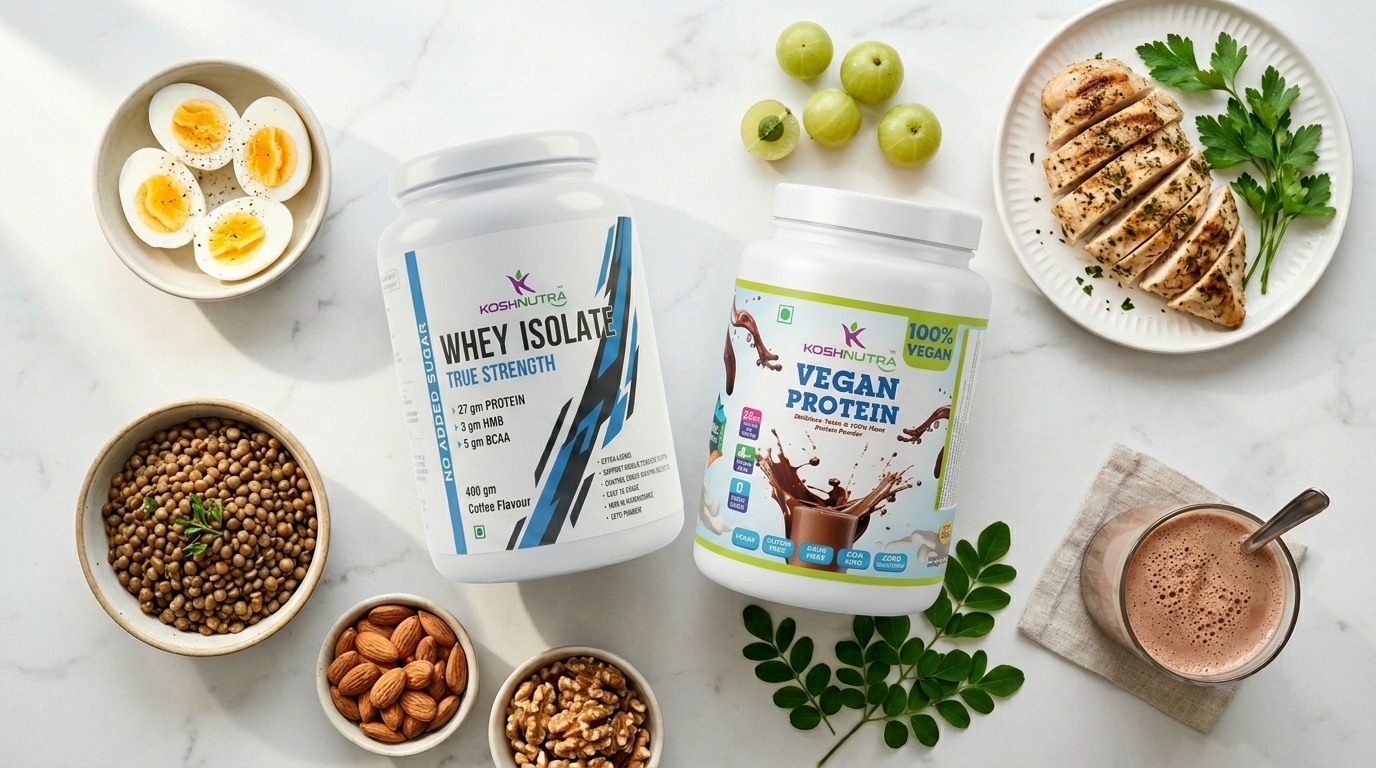
Koshnutra Whey Isolate
What it is: A premium whey isolate protein formulated for strength, recovery, and complete metabolic support. Coffee Flavour | 400g
Who it is for: Gym enthusiasts, athletes, diabetic patients, menopausal women, and older adults seeking to preserve muscle and metabolic health.
Key Ingredients and What They Do:
- 27g Protein per serving — one of the highest concentrations available in a clean whey isolate format
- 3g HMB (Beta-Hydroxy Beta-Methylbutyrate) — a metabolite of leucine that prevents muscle protein breakdown (anti-catabolism) and accelerates lean muscle gain, particularly during calorie restriction or aging. Backed by clinical studies showing benefits in both athletes and older adults
- 5g BCAA — leucine, isoleucine, and valine in a ratio that maximally stimulates muscle protein synthesis post-workout
- Omega-3 Fatty Acids — reduces exercise-induced inflammation, supports cardiovascular health, and improves joint recovery
- Chromium — an essential trace mineral that improves insulin sensitivity and helps regulate blood glucose — making this formula specifically suitable for diabetics
- Inulin Fiber — a prebiotic that feeds beneficial gut microbiota, supports bowel regularity, and improves long-term digestive health
- Added Vitamins and Minerals — comprehensive micronutrient support for overall daily health
- No Added Sugar | No Maltodextrin | Non-GMO | Gluten Free
Why Koshnutra Whey Isolate stands out: Most whey protein products stop at protein content. Koshnutra goes further by including HMB for anti-catabolic protection, Omega-3 for recovery and heart health, and Chromium for blood sugar control. This makes it one of the few protein supplements in India that is specifically appropriate for diabetics, menopausal women, and geriatric users — populations that most brands overlook entirely.
→ Learn more here
Koshnutra Vegan Protein (Plant-Based Power for Everyday Nutrition)
What it is: A 100% plant-based protein powder built on a clinically validated pea + rice protein base, enriched with functional superfoods and a digestive enzyme system. Chocolate Hazelnut Flavour | 100% Plant-Based
Who it is for: Vegetarians, vegans, beginners, people with IBS, IBD, celiac disease, or thyroid conditions, and anyone avoiding dairy, soy, or artificial additives.
Key Ingredients and What They Do:
- Pea Protein Isolate + Brown Rice Protein — together, these two sources deliver a complete essential amino acid profile with a PDCAAS comparable to animal protein. The combination resolves the lysine and methionine gaps that each source has individually
- Moringa — one of the most nutrient-dense plants on earth. Rich in iron, calcium, vitamins A, C, and E, and natural antioxidants. Moringa supports energy levels, immune function, and anti-inflammatory activity
- Grape Seed Extract — a concentrated source of oligomeric proanthocyanidins (OPCs), among the most potent antioxidants known. Supports cardiovascular health, skin integrity, and long-term cellular protection
- Garcinia and Mangosteen — support healthy weight management by inhibiting fat accumulation and reducing appetite signals
- Green Tea Extract — promotes fat oxidation and sustained energy through EGCG and natural caffeine, without jitteriness
- Digestive Enzyme Blend — breaks down plant proteins more efficiently, directly addressing the most common complaint about vegan protein: bloating and poor absorption
- Guar Gum and Fenugreek Fiber — slow gastric emptying to create lasting fullness, reduce post-meal blood glucose spikes, and support healthy gut motility
- 100% Soya Free — critical for individuals with thyroid conditions, as soy can interfere with thyroid hormone absorption
- Non-GMO | Gluten Free | Maltodextrin Free | Zero Sucralose | Vegan Certified
Why Koshnutra Vegan Protein stands out:
Most plant-based proteins are single-ingredient isolates with poor digestibility and incomplete amino profiles. Koshnutra Vegan Protein is a functional nutrition system. The digestive enzyme blend directly solves the absorption problem that plagues most vegan proteins. The superfood matrix — moringa, grape seed extract, green tea — delivers antioxidant, metabolic, and immune benefits that no standard protein powder offers. It is also one of the only vegan proteins on the Indian market explicitly formulated safe for IBS, IBD, celiac disease, and thyroid disease.
→ Learn more here
Which Koshnutra Product Is Right for You?
| Your Situation | Recommended Product |
|---|---|
| You train at the gym 3+ times per week | Whey Isolate |
| You are vegetarian or vegan | Vegan Protein |
| You have type 2 diabetes | Whey Isolate (Chromium + no added sugar) |
| You have IBS, IBD, or celiac disease | Vegan Protein (enzyme blend + soy-free) |
| You are over 60 and concerned about muscle loss | Whey Isolate (HMB + BCAA) |
| You want to manage weight and support detox | Vegan Protein (Garcinia + Green Tea) |
| You are menopausal and want bone + muscle support | Whey Isolate (Omega-3 + bone-supportive formula) |
| You have thyroid disease | Vegan Protein (100% soy-free) |
| You want everyday wellness and immunity | Either — based on your dietary preference |
Contact Koshnutra: Website: www.koshnutra.com Email: support@koshnutra.com Phone: +91 9130750170 Manufactured in India. Quality Tested.
The Risks of Too Little and Too Much Protein
Signs You Are Not Getting Enough Protein
Protein deficiency does not always look obvious. Watch for these signs:
- Persistent hunger and uncontrollable cravings — especially for sugar and refined carbs
- Slow wound healing and frequent illness
- Hair thinning, breakage, or loss
- Brittle nails
- Muscle weakness and easy fatigue
- Brain fog and difficulty concentrating
- Fluid retention or swelling (edema) in severe cases
If you recognize several of these symptoms, increasing your daily protein intake is one of the first interventions to try.
Can You Eat Too Much Protein?
For healthy adults, the evidence does not support a strict upper limit. Intakes up to 2.5 g/kg appear safe in people with healthy kidneys. However, extremely high intakes (above 3.0 g/kg) without adequate fiber and hydration may increase uric acid production and contribute to digestive discomfort in some individuals.
The practical rule: balance protein with adequate water intake (at least 2–3 liters daily), fiber-rich vegetables, and healthy fats. If you have any pre-existing kidney condition, consult a physician before significantly increasing your protein intake.
Conclusion
Protein is not a supplement trend. It is a biological necessity. From controlling hunger and building muscle to supporting your brain, bones, immune system, and hormones, adequate protein intake touches nearly every aspect of your health.
The evidence is consistent: most adults benefit from eating more protein than they currently do — not just athletes, but people managing weight, dealing with aging, recovering from illness, or trying to feel more energetic every day.
If you are looking for a clean, clinically thoughtful protein source, Koshnutra Whey Isolate and Koshnutra Vegan Protein offer two of the most complete and honest formulas available in India — free of maltodextrin, soy (in the vegan formula), artificial fillers, and unnecessary additives.
Start with your goal. Match your protein source to your body. Stay consistent.
Scientific References
- U.S. Department of Agriculture and U.S. Department of Health and Human Services. Dietary Guidelines for Americans, 2020–2025. 9th Edition. Available at: dietaryguidelines.gov
- Morton, R.W., Murphy, K.T., McKellar, S.R., et al. (2018). A systematic review, meta-analysis and meta-regression of the effect of protein supplementation on resistance training-induced gains in muscle mass and strength in healthy adults. British Journal of Sports Medicine, 52(6), 376–384. PMC8978023
- Koliaki, C., et al. (2020). The role of dietary protein in managing hunger and satiety: a systematic review. Physiology & Behavior, 228, 113202. PMC7539343
- Weikert, C., et al. (2022). Protein intake and bone health in older adults. Nutrients, 14(3), 689. PMC9891984
- Baum, J.I., Kim, I.Y., & Wolfe, R.R. (2016). Protein consumption and the elderly: What is the optimal level of intake? Nutrients, 8(6), 359. PMC10649897
- Pesta, D.H., & Samuel, V.T. (2014). A high-protein diet for reducing body fat: mechanisms and possible caveats. Nutrition & Metabolism, 11(1), 53. PMC6087750
- Rebholz, C.M., et al. (2023). Higher protein intake is associated with lower blood pressure in the general population. Journal of Hypertension, PMC10005279
- Appel, L.J., et al. (2010). Effects of protein, monounsaturated fat, and carbohydrate intake on blood pressure: The OmniHeart randomized trial. JAMA, 294(19), 2455–2464. PMC2920332
- Carbone, J.W., & Pasiakos, S.M. (2019). Dietary protein and muscle mass: Translating science to application and health benefit. Nutrients, 11(5), 1136. PMC8970868
- Stokes, T., et al. (2018). Recent perspectives regarding the role of dietary protein for the promotion of muscle hypertrophy with resistance exercise training. Nutrients, 10(2), 180.
- National Kidney Foundation. (2023). CKD Diet: How Much Protein Is the Right Amount? Available at: kidney.org
- Halton, T.L., & Hu, F.B. (2004). The effects of high protein diets on thermogenesis, satiety and weight loss: A critical review. Journal of the American College of Nutrition, 23(5), 373–385.
- Leidy, H.J., et al. (2014). The role of protein in weight loss and maintenance. American Journal of Clinical Nutrition, 101(6), 1320S–1329S. PMC4249715
- Paddon-Jones, D., & Rasmussen, B.B. (2009). Dietary protein recommendations and the prevention of sarcopenia: Protein, amino acid metabolism and therapy. Current Opinion in Clinical Nutrition and Metabolic Care, 12(1), 86–90.
- Young, S.N. (2007). How to increase serotonin in the human brain without drugs. Journal of Psychiatry & Neuroscience, 32(6), 394–399.


